
Review · DOWNTOWN LA TOURS
The History and Architecture of Downtown Los Angeles
DTLA history shows up on every block. I like how this tour turns downtown streets into a living timeline, starting with a ride on Angels Flight that shows up in movies and TV all the time. You’ll connect big architectural landmarks to the LA stories you’ve already heard.
My other favorite part is the mochi stop in Little Tokyo at Fugetsu-Do, where you sample a treat from LA’s oldest confectionery. It’s a quick flavor break that also makes the neighborhood feel real, not just photographed.
One thing to plan for: this is a longer 3-hour walking route with a few slight slopes, and it’s not suitable for people with mobility impairments. Wear shoes you trust, and bring water.
In This Review
- Quick hits from the route that people love most
- Start at 341 S Hill St and ride Angels Flight like LA TV always does
- Bunker Hill’s uphill past: more than a backdrop
- Architecture on display: Disney Concert Hall, The Broad, and the Music Center
- Civic Center City Hall: the courtroom stories behind the movie scenes
- Little Tokyo’s 1903 Fugetsu-Do mochi: a sweet reset
- Historic Core showstoppers: Bradbury Building and The Last Bookstore
- Biddy Mason Memorial Park and Vibiana: quieter pauses that add depth
- Grand Central Market: where to eat after the walking
- Price and value: what you really get for $39
- Guide quality: Chris is the product
- Who should book this Downtown Los Angeles tour
- Should you book it?
- FAQ
- How long is the tour?
- What does it cost?
- What’s included in the price?
- Is the Angels Flight ride included?
- Where do I meet the guide?
- What should I bring?
- Are there restrooms nearby?
- Is parking available?
- Is alcohol allowed?
- What’s the cancellation policy?
Quick hits from the route that people love most
- Angels Flight funicular ride with plenty of photo time and movie/TV history baked in
- Bunker Hill perspective on how the area’s community depended on the funicular
- Architecture stops with big-name designers like Frank Gehry and Arata Isozaki in the mix
- Civic Center City Hall court stories tied to major cases and pop-culture courtroom scenes
- Fugetsu-Do mochi in Little Tokyo with a 1903 storefront feel
- Bradbury Building + Last Bookstore for classic downtown atmosphere (including a sci-fi connection)
Deeper into Downtown LA
- Old and New Downtown Los Angeles Walking Tour★ 5.0 · 222 reviews
- Culture and Arts Tour of Downtown LA with Angels Flight Ticket★ 5.0 · 142 reviews
- The History and Architecture of Downtown Los Angeles★ 5.0 · 94 reviews
Start at 341 S Hill St and ride Angels Flight like LA TV always does
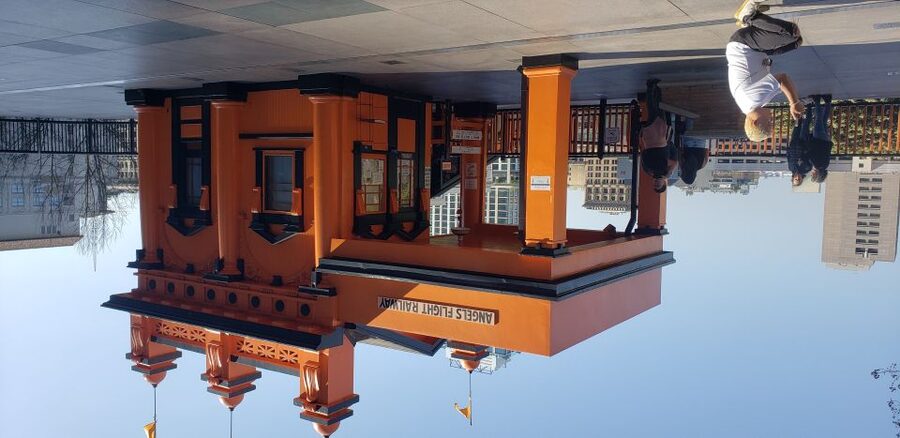
You meet at 341 S Hill St, at the lower part of Angels Flight. Look for the stairs area to the left of the train, and you’ll know you’re in the right spot. This start matters because it drops you right into the “how LA works” theme: elevation, movement, and the way people used infrastructure long before the city became a brand.
Then you ride. Angels Flight is a historic 1901 funicular, and it’s been used in lots of film and TV. The payoff isn’t just the cable-car photos. It’s the story your guide builds around the idea that downtown neighborhoods weren’t always flat and easy. You’ll learn why people relied on this system in daily life, and that makes the rest of the walk click faster.
One practical perk: your guide, Chris, pays for the Angels Flight ticket as part of the tour. So you’re not juggling small add-on costs before you even get moving.
Bunker Hill’s uphill past: more than a backdrop
After the funicular, you head into the Bunker Hill area and slow down for the neighborhood story. This is where downtown history stops being a list of dates and becomes a sense of place. You’ll talk about the community that once depended on Angels Flight and how that helped shape what the area became.
It’s also a smart way to get your bearings. Bunker Hill sits right where a lot of downtown’s key institutions cluster, so you’ll see museums, performing arts venues, and governmental buildings along the way. Rather than rushing from stop to stop, you’re building context: why these buildings ended up here, and how downtown grew from a small beginning into a city big enough to make headlines worldwide.
If you like architecture, this segment is a warm-up. You start training your eye for style changes across eras, from civic weight to arts-and-culture statements.
Architecture on display: Disney Concert Hall, The Broad, and the Music Center
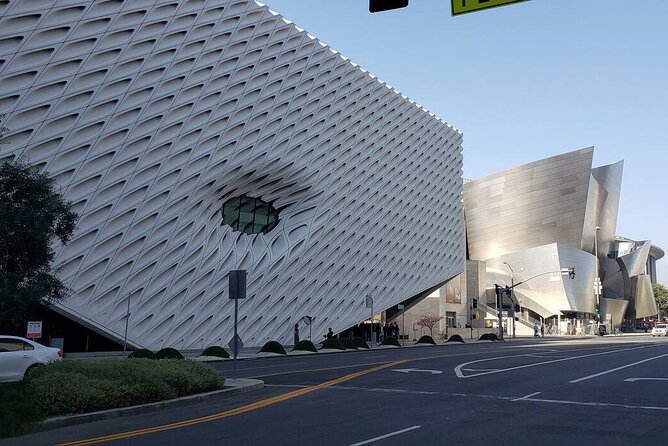
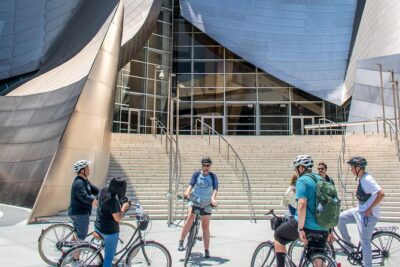
Next, you move into a stretch that’s basically a crash course in modern downtown design. You’ll spend time around major landmarks including Walt Disney Concert Hall, The Broad, and the Music Center. The focus isn’t just what these buildings look like. It’s how they represent LA’s shift from “future-proofing by expansion” to “future-proofing by signature design.”
This matters for your understanding because LA has always had two modes at once: growth and reinvention. Downtown is where those modes show up loudest. The tour highlights development stories and points out the architectural fingerprints of Pritzker Prize–winning architects, including Frank Gehry and Arata Isozaki.
You’ll also get useful interpretation as you walk. Instead of only pointing at surfaces, Chris connects design choices to the cultural priorities behind them: why a city invests in bold silhouettes, and what it tries to signal to the rest of the world.
Time check: you’ll get guided time at the Concert Hall area, with photo moments built in. If you’re the type who likes to actually look instead of just snap and walk, this portion will feel satisfying.
Civic Center City Hall: the courtroom stories behind the movie scenes
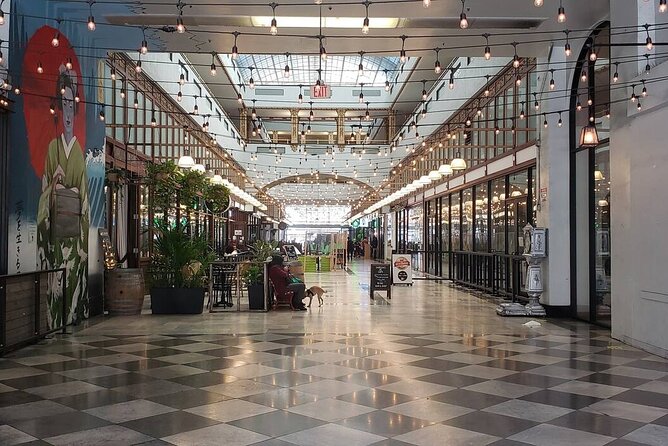
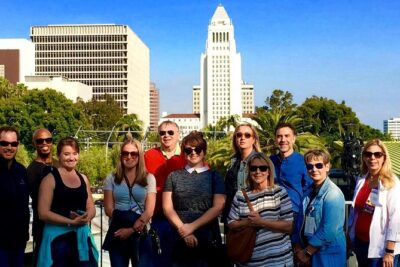
Then the tour hits one of downtown LA’s biggest magnets: the Civic Center, with City Hall as the headline. This is where Los Angeles becomes cinematic in a different way. City Hall has shown up in movies and TV again and again—think Batman, Superman, War of the Worlds, Lincoln Lawyer, Rookie, and Dragnet. The building itself is impressive, but the stories are what make it stick.
Here’s the extra layer that makes this stop memorable: you’ll also learn about famous cases tied to the court system. The tour includes where OJ, The Nightstalker, Bugsy Siegel, and Charles Manson went to court. Even if true crime isn’t your thing, it helps you understand why certain downtown buildings feel heavy and important. They’re not just backdrops. They’ve hosted real decisions.
The guided walk through the Civic Center is also practical. It teaches you to spot institutional architecture at street level—how scale, materials, and entrances communicate power. That’s the kind of skill that pays off when you later explore LA on your own.
More Los Angeles outings we have rated and written up
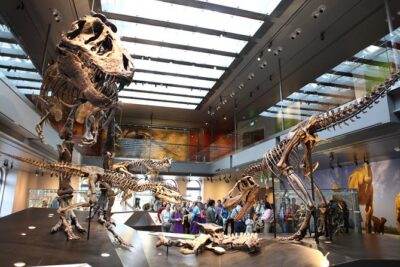
Little Tokyo’s 1903 Fugetsu-Do mochi: a sweet reset
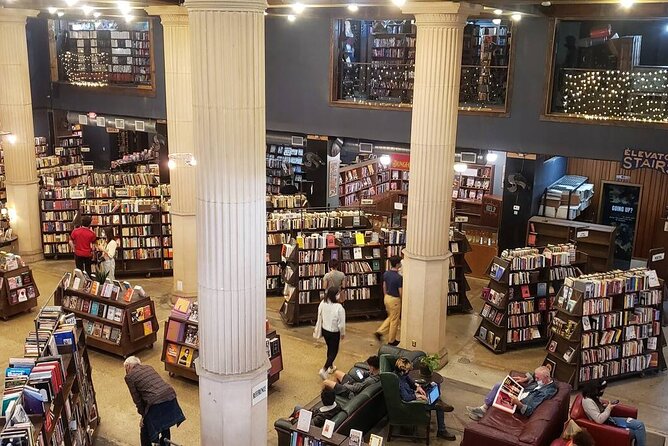
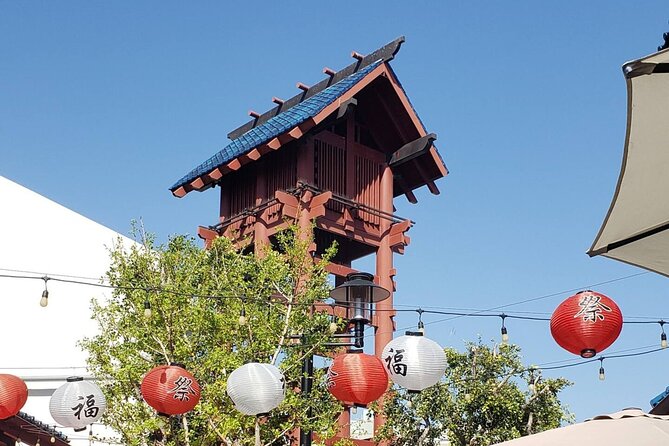
After the civic stops, you ease into Little Tokyo—one of the most fun parts of downtown to explore, and a neighborhood with a history full of ups and downs. This isn’t just a quick pass-by. You’ll get guided time that helps you understand how the area evolved and why it matters culturally.
The highlight here is the break at Fugetsu-Do Bakery Shop, a 1903 confectionery where you sample mochi. The mochi tasting is included, and it’s a smart inclusion because it’s both food and orientation. You’ll have a moment to slow down, cool off if the weather is warm, and reset your senses before the final stretch.
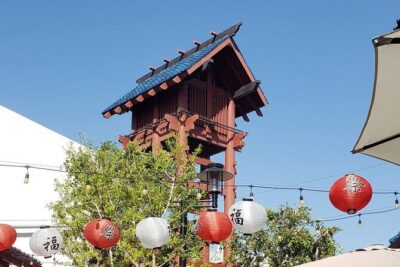
From there, you continue through Japanese Village Plaza and along Astronaut Ellison S Onizuka Street, with more guided sightseeing time. This section works well for a mixed group: architecture lovers get details, film fans get atmosphere, and food people get the one thing they came for.
And yes, on hot days, the guide makes a difference. Multiple bookings mention shade and hydration care—exactly what you want when you’re doing a few miles on foot.
Historic Core showstoppers: Bradbury Building and The Last Bookstore
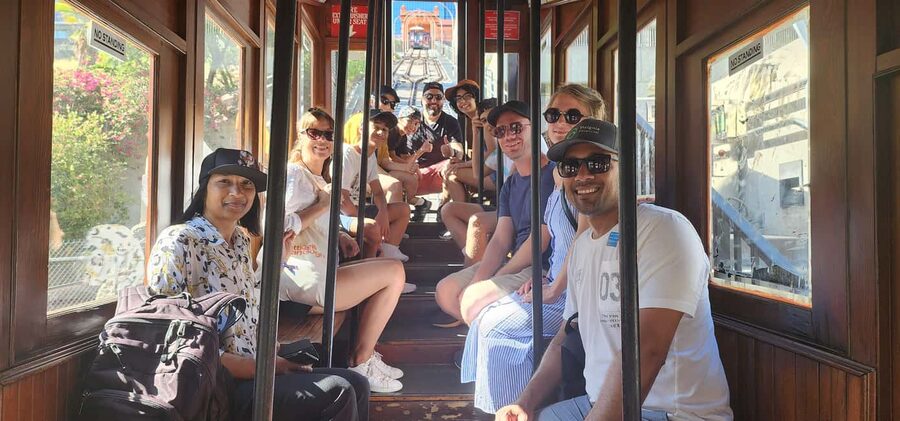
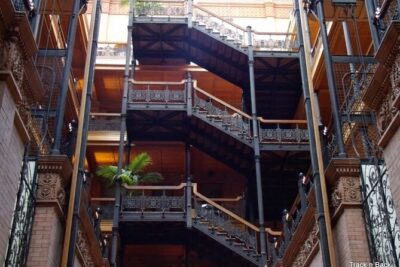
Now you enter the Historic Core, where downtown goes from “interesting” to “how is this real?” The big star is the Bradbury Building. When you step inside, it feels like time travel. It also has a major connection to the sci-fi classic Blade Runner, so you’ll see the building through two lenses: architecture and movie imagination.
If you’re someone who reads signs and takes the details seriously, this is your moment. The structure gives you plenty to look at without feeling like a museum lecture. It’s visually dramatic and easy to photograph, but the guide keeps it grounded with history and why the building matters.
Right after that, you’ll head to The Last Bookstore, set inside of a 1915 bank. It’s one of those places where you can lose track of time for a reason: the space has personality. You’ll get guided time, but you’ll also have enough room to wander a bit and take in the vibe.
This pairing is a clever way to balance your downtown experience. Bradbury Building gives you old-school architectural wonder. The Last Bookstore gives you a modern LA obsession: reusing and reimagining space.
Biddy Mason Memorial Park and Vibiana: quieter pauses that add depth
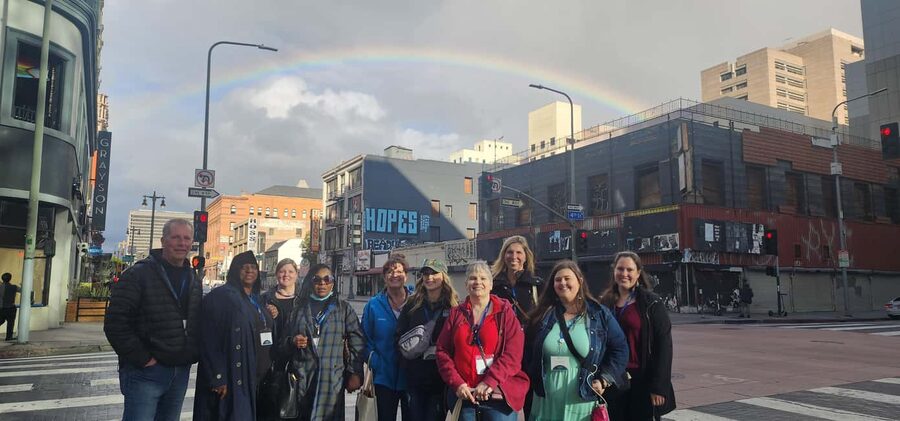
Not every stop is a headline. You’ll also visit Biddy Mason Memorial Park, which adds an important layer to the story of who shaped downtown LA. It’s a shorter stop, but it changes the tone of the walk in a good way. You stop thinking only about buildings and start thinking about people.
And you’ll spot Vibiana along the route as a sightseeing pass-by. Even without a long dwell time, it’s part of what makes downtown feel layered rather than one-note.
These short segments matter because the whole tour works like a mixtape. You need a few quiet tracks so the loud, cinematic buildings don’t blur together.
Grand Central Market: where to eat after the walking
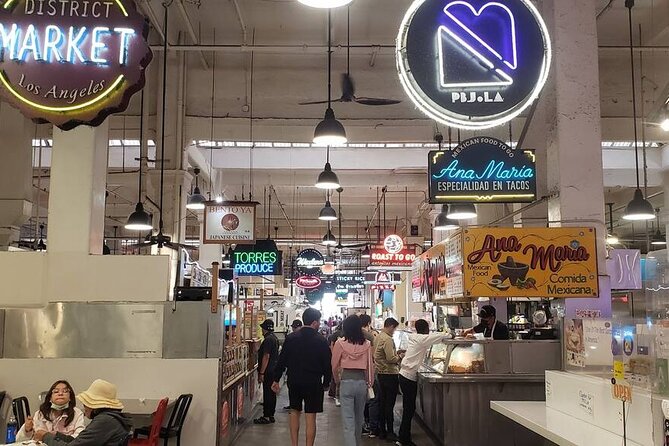
The tour ends in the area of Grand Central Market, one of downtown LA’s most practical food hubs. You’ll get guided time there, including recommendations for where to grab the best meal in the market.
This part is useful even if you’re not sure what you want. Downtown walking can make your decision-making weird. Having a plan helps. Plus, Grand Central Market is also a good place for a bathroom break during the day since there are restrooms across from the meeting area and within the general complex.
If you’re driving, note that there is parking at Grand Central Market and nearby lots, and prices are typically $10–$20 per day.
Price and value: what you really get for $39
At $39 per person for about 3 hours, you’re paying for more than sightseeing. You’re paying for someone who can connect architecture to film locations and major real-world court history, without turning it into a lecture. That combo is rare.
You also get two “included” pieces that make the tour feel complete: the guide and the mochi sample in Little Tokyo. And because the Angels Flight ticket is covered by the guide as part of the experience, you avoid one common mid-tour annoyance: unexpected small costs when you’re already committed.
The value gets even better if you’re the kind of person who likes to understand what you’re looking at. If you just want quick photos, you might feel ready to move faster than the tour pace.
Guide quality: Chris is the product
The biggest reason this tour works for many people is the guide: Chris. He’s described as funny, patient, and extremely attentive. Importantly, you’re guaranteed the tour creator as your guide, not someone reading from a script.
You’ll hear plenty of architecture and history, but you’ll also get film and TV connections, plus true-crime courtroom context. Some bookings specifically mention that Chris isn’t stumped by questions and can link LA themes across topics, including nods to well-known noir and detective-style storytelling.
There’s also a real-world credibility layer: Chris has led tours for KTLA, Spectrum News1, and NHK Japan. That kind of background usually translates into clearer explanations and smoother pacing.
Who should book this Downtown Los Angeles tour
This is a strong fit if you want:
- Architecture and city-design context with names and eras you can actually remember
- Film-location energy without spending the whole day in traffic
- A walk that includes both big landmarks and downtown texture like Little Tokyo sweets and bookshop atmosphere
- A guide who answers questions and adapts on the fly (especially on hot days)
It’s not ideal if:
- You can’t handle a few miles of walking and slight slopes
- You want minimal walking and maximum sitting
- You’re only chasing one single neighborhood (this route covers several)
Should you book it?
I’d book this if downtown is the heart of your LA visit. The mix of Angels Flight, architectural icons, City Hall’s court stories, and Little Tokyo’s mochi stop gives you a version of LA that feels lived-in, not just landmark-shaped.
If you’re short on time but want depth, this 3-hour format is a good deal. If you want a relaxed, mostly-easy stroll, choose a comfortable time of day, bring water, and wear shoes with grip—because downtown adds small hills without asking permission.
FAQ
How long is the tour?
The tour lasts 3 hours.
What does it cost?
It’s $39 per person.
What’s included in the price?
The tour includes the guide and a mochi sample in Little Tokyo.
Is the Angels Flight ride included?
The guide pays for the Angels Flight ticket as part of the tour.
Where do I meet the guide?
You meet at 341 S Hill St, at the lower part of Angels Flight, near the stairs to the left of the train.
What should I bring?
Bring comfortable shoes, a camera, and water.
Are there restrooms nearby?
There are restrooms across from the meeting point in Grand Central Market, and there are a couple opportunities once the tour begins.
Is parking available?
Yes. There’s parking at Grand Central Market and lots nearby, usually $10–$20 per day.
Is alcohol allowed?
No. Alcohol and drugs are not allowed.
What’s the cancellation policy?
You can cancel up to 24 hours in advance for a full refund. You can also reserve now and pay later.
More Historical Tours in Los Angeles
- Natural History Museum of Los Angeles County Admission
★ 4.5 · 111 reviews - The History and Architecture of Downtown Los Angeles
★ 5.0 · 94 reviews - Downtown Los Angeles History and Architecture Walking Tour
★ 5.0 · 93 reviews - Los Angeles: Dark History and Haunted LA Ghost Bus Tour
★ 3.8 · 33 reviews - Los Angeles: Downtown History & Architecture Walking Tour
★ 4.6 · 25 reviews
More Tour Reviews in Los Angeles
- Full-Day Iconic Sights of LA, Hollywood, Beverly Hills, Beaches and More
★ 5.0 · 6,147 reviews - Warner Bros. Studio Tour Hollywood
★ 4.5 · 5,246 reviews - Hollywood, Beverly Hills & Celebrity Homes Tour by Open Air Bus
★ 5.0 · 2,557 reviews - Hollywood Sign 2.5-Hour Tour with Comedians and Their Dogs
★ 5.0 · 2,496 reviews - Full-Day LA Tour: Santa Monica, Hollywood and Beverly Hills
★ 5.0 · 2,431 reviews
Keep Going in Downtown LA
- Downtown Los Angeles Food Tour
★ 5.0 · 501 reviews - Old and New Downtown Los Angeles Walking Tour
★ 5.0 · 222 reviews - Culture and Arts Tour of Downtown LA with Angels Flight Ticket
★ 5.0 · 142 reviews - The History and Architecture of Downtown Los Angeles
★ 5.0 · 94 reviews - Downtown Los Angeles History and Architecture Walking Tour
★ 5.0 · 93 reviews
Keep exploring Los Angeles: fresh reviews from around town


Downtown LA Tours, compared.
 ★ 5.0Downtown Los Angeles Food TourFrom $89501 reviews
 ★ 5.0Old and New Downtown Los Angeles Walking TourFrom $38222 reviews
 ★ 5.0Culture and Arts Tour of Downtown LA with Angels Flight TicketFrom $39142 reviews
 ★ 5.0The History and Architecture of Downtown Los AngelesFrom $3994 reviews
 ★ 5.0Downtown Los Angeles History and Architecture Walking TourFrom $3593 reviews
 ★ 5.0Downtown Los Angeles Bike TourFrom $8276 reviews
 ★ 5.0Downtown Los Angeles Architecture Walking TourFrom $3873 reviews
 ★ 4.5DTLA Murder Mystery Ghost TourFrom $6064 reviews
Browse the lists this tour appears in